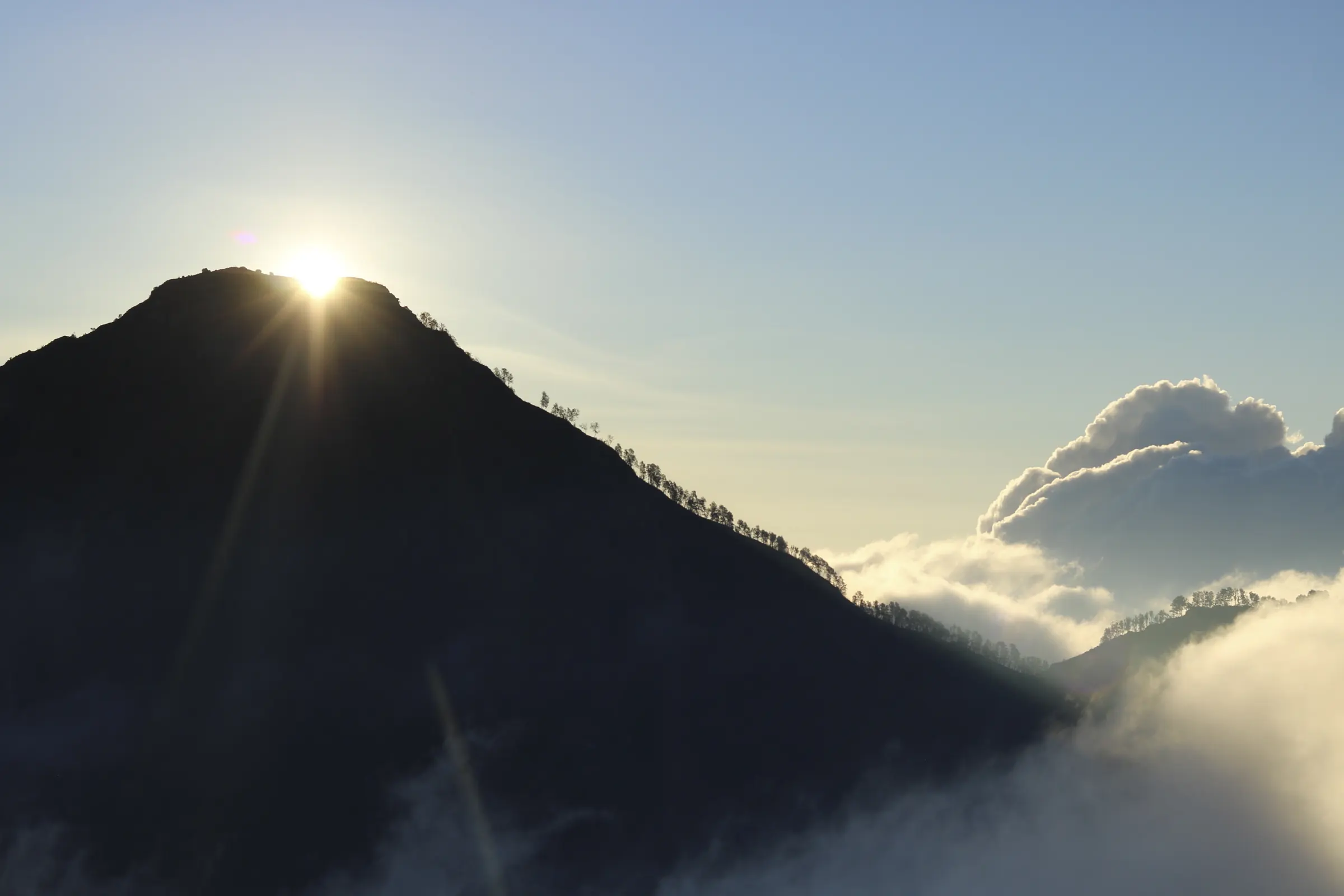
Rinjani and Bromo get compared constantly, but they are not the same kind of trek. Rinjani means two or three days on the mountain, a night in a tent on the crater rim and a 2am climb to 3,726 m. Bromo means a jeep at half past three in the morning, sunrise over the caldera, and breakfast back at your hotel. Both are worth doing. What follows is the detail that decides which one belongs in your trip.
Side by side
Indonesia has more than 130 active volcanoes. These two draw most of the trekking traffic, and almost nothing about them is comparable.
What each one actually is
Same island chain, same volcanic landscape, two completely different kinds of trip. One is a sunrise you drive to. The other is days of walking.
A multi-day trek through volcanic wilderness
Rinjani is not a day trip. You start in Sembalun village, climb through forest and grassland, camp on the crater rim at 2,641 m, and push for the summit at 2am. The reward at the top is Lombok, Bali and the sea laid out beneath you. Inside the caldera sits Segara Anak, a turquoise crater lake at 2,000 metres: on the 3-day route you descend to the shore, soak in the natural hot springs after lunch, and camp at the water’s edge before climbing out to Senaru on the last day. It is quiet, the kind of quiet most people forget exists. You need reasonable fitness, not mountaineering experience. The summit push is steep and the scree is loose, but your guides carry most of the gear and your porters cook the meals. You walk.
A sunrise you drive to
Bromo is a sunrise destination. You drive to the Penanjakan viewpoint around 3:30am, watch the sun come up over the Tengger caldera, then drive or walk across the sand sea to the smoking crater. The walk up to the crater rim is about 250 steps. By mid-morning you are back at your hotel. The landscape is striking: a flat volcanic plain surrounded by crater walls, with Bromo’s cone rising from the centre, and on clear mornings you can see Semeru, Java’s highest peak, smoking in the background. No camping, no steep climbing. Children and older travellers do it regularly, and it works well as a side trip from Surabaya or as part of a Java overland route.
What each one costs
Rinjani is the more expensive by a wide margin, and the difference is what the money covers: days, not hours.
Rinjani, 2 or 3 days
Most trekkers choose the 2-day or 3-day package. The 2-day starts at $210, the 3-day with the lake and the hot springs at $250. Everything is included, so there is nothing left to pay on the mountain.
- Guides, porters and all meals
- Camping gear and national park fees
- Pick-up from the airport, Mataram, Senggigi or Bangsal Harbor
Bromo, one morning
A jeep tour from Cemoro Lawang runs $30 to $50 per person. Independent travellers pay less. Accommodation in the area is basic and cheap.
- Jeep to the sunrise viewpoint
- No guide required, no camping gear
- Cheap, basic rooms on the crater rim
To hold a Rinjani date you send a free request, I confirm it, and then you pay a deposit of $30 per person online. That deposit is part of the trek price, and the rest you pay your guide in cash on Lombok.
Which one belongs in your trip
Bromo is a good experience. It is easy to reach, easy to do, and the sunrise is worth waking up for. Rinjani asks two or three days and gives back something else entirely.
Choose Bromo if
- You have half a day. Arrive in the late afternoon, sleep in a nearby town, watch the sunrise and move on.
- You would rather not camp. No tent, no steep climbing, about 250 steps to the crater rim.
- Your dates fall between January and March. Rinjani’s park is closed then. Bromo runs year-round, driest from April to October.
- You are already on Java. Surabaya is a 3–4 hour drive from Cemoro Lawang, or a train to Probolinggo and a minibus from there.
Choose Rinjani if
- You want to earn it. Two or three days of walking, a night on volcanic rock at 2,641 m, and a summit you climb in the dark.
- You want the crater lake. Segara Anak and the hot springs sit on the 3-day summit and lake route, and they are the reason people add the day.
- You are travelling in the dry season. April to November gives the best conditions, and June and September balance good weather with fewer crowds. The month-by-month guide has the rest.
- Lombok is already on your route. Two hours by fast boat from Padang Bai, or fly into Lombok (LOP) and drive 2.5 hours to Sembalun.
If you have the time and the legs for it, Rinjani is the deeper experience: a crater lake you can swim in, a summit you earned, and a silence that stays with you after you come down. It is not comfortable. The best things on this planet rarely are.
"Zain was a good guide, funny, help when needed, he likes bruno mars so sing with him to walk faster. Anyway the walk was so hard (i cried) but i the end i was so happy to be here."
If it is going to be Rinjani
Then this is the part that decides how it goes. I wrote down whether you can do it, when to come, and how to train for it. Free.
Inside: whether you can actually do this, the month I would pick, how to train for it, and the summit push step by step.
The kit is on its way to your inbox. Sometimes it lands in spam.
Zainal, your guideTen years of walking people up this mountain, written down.

Frequently asked questions
Which is better for beginners, Rinjani or Bromo?
Bromo is more suitable for beginners: it requires minimal fitness and is done in a few hours. Rinjani is a multi-day wilderness trek at altitude that requires a good base level of fitness. That said, Rinjani is achievable for most people who are reasonably active. The reward is proportionally greater.
How many days do you need for Mount Bromo?
Most visitors do Bromo in 1 day or overnight: arriving in the late afternoon, sleeping in a nearby town, and watching sunrise from the viewpoint before returning. No guide is required and no camping is involved.
Is Rinjani more expensive than Bromo?
Yes. Rinjani treks start from $210 per person all-inclusive (2 days, guides, meals, camping gear, park fees), dropping to $190 once three trekkers have paid for the same date. Bromo is significantly cheaper: typically $30–50 for a jeep tour and sunrise viewpoint. The price difference reflects the multi-day guided wilderness experience.
Can you visit both Rinjani and Bromo on one trip to Indonesia?
Yes, and many travellers do. A common route: fly into Bali, fast boat to Lombok for the trek (2–3 days), fast boat back to Bali or ferry to Java, then overland to Bromo (1–2 days). Budget at least 8–10 days in total to do both without rushing.
Is Rinjani harder than Kilimanjaro?
Kilimanjaro (5,895 m) is significantly higher and takes 6–8 days, so in terms of altitude and duration it is more demanding. Rinjani at 3,726 m is steeper and more technically varied: loose volcanic scree, crater rim camping, and a pre-dawn summit push. Kilimanjaro is walked more gradually on wider trails. Most trekkers who have done both describe Rinjani as harder per day, Kilimanjaro as harder overall due to altitude.
Is Rinjani harder than Semeru?
Mount Semeru (3,676 m) and Mount Rinjani (3,726 m) are similar in altitude. Rinjani’s full 3-day trek is considered more complete as an experience: summit, crater lake, and hot springs. Semeru’s summit push is steeper and involves deep sand sections (the famous ‘pasir berbisik’). Both are serious treks requiring fitness and a licensed guide. Rinjani offers more varied scenery over multiple days.
Ready to see Rinjani for yourself?
Tell me your dates and how much walking you actually do, and I will say whether the 2-day or the 3-day is the honest choice for you. If your dates fall in the closed season, I will say that too.